

Law Of Multiple Proportions Dalton
2.5: The Law of Multiple Proportions and Dalton's Atomic Theory
- Page ID
- 95108
- Explicate how all thing is equanimous of atoms.
- Describe the modern atomic theory.
Take some aluminum foil. Cutting it in one-half. At present there are two smaller pieces of aluminum foil. Cutting one of the pieces in one-half again. Cut ane of those smaller pieces in half again. Go along cutting, making smaller and smaller pieces of aluminum foil. It should be obvious that the pieces are however aluminum foil; they are merely becoming smaller and smaller. Merely how far can this exercise exist taken, at least in theory? Can one go on cut the aluminum foil into halves forever, making smaller and smaller pieces? Or is there some limit, some absolute smallest piece of aluminum foil? Thought experiments similar this—and the conclusions based on them—were debated equally far dorsum as the 5th century BC.
John Dalton (1766-1844) is the scientist credited for proposing the atomic theory. The theory explains several concepts that are relevant in the observable world: the composition of a pure gold necklace, what makes the pure gilded necklace unlike than a pure argent necklace, and what occurs when pure gold is mixed with pure copper. This section explains the theories that Dalton used as a basis for his theory: (1) Law of Conservation of Mass (2) Law of Definite Proportions, and (3) Constabulary of Multiple Proportions
Police ane: The Conservation of Mass
"Nothing comes from null" is an important thought in aboriginal Greek philosophy that argues that what exists now has always existed, since no new matter can come up into beingness where there was none before. Antoine Lavoisier (1743-1794) restated this principle for chemistry with the constabulary of conservation of mass, which "means that the atoms of an object cannot be created or destroyed, but tin can be moved effectually and be changed into different particles." This law says that when a chemical reaction rearranges atoms into a new product, the mass of the reactants (chemicals before the chemic reaction) is the aforementioned as the mass of the products (the new chemicals made). More than simply, whatever yous do, you will still have the same amount of stuff (however, certain nuclear reactions like fusion and fission can convert a small role of the mass into energy.
The constabulary of conservation of mass states that the full mass present before a chemical reaction is the same as the total mass present afterward the chemical reaction; in other words, mass is conserved. The police of conservation of mass was formulated by Lavoisier as a result of his combustion experiment, in which he observed that the mass of his original substance—a drinking glass vessel, tin can, and air—was equal to the mass of the produced substance—the glass vessel, "tin calx", and the remaining air.
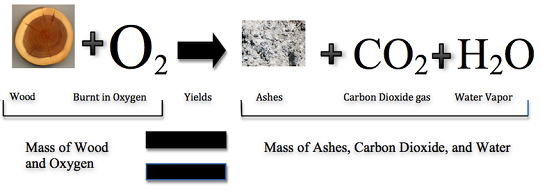
Historically, this was a difficult concept for scientists to grasp. If this law was true, then how could a large slice of forest be reduced to a modest pile of ashes? The forest conspicuously has a greater mass than the ashes. From this observation scientists ended that mass had been lost. All the same, Figure \(\PageIndex{1}\) shows that the burning of word does follow the law of conservation of mass. Scientists did not business relationship for the gases that play a disquisitional role in this reaction.
The law of conservation of mass states that the total mass present earlier a chemical reaction is the same as the total mass present later on the chemic reaction.
Law 2: Definite Proportions
Joseph Proust (1754-1826) formulated the law of definite proportions (also called the Law of Constant Composition or Proust'due south Law). This law states that if a compound is broken down into its elective elements, the masses of the constituents volition always have the same proportions, regardless of the quantity or source of the original substance. Joseph Proust based this law primarily on his experiments with basic copper carbonate. The analogy below depicts this police in activity.
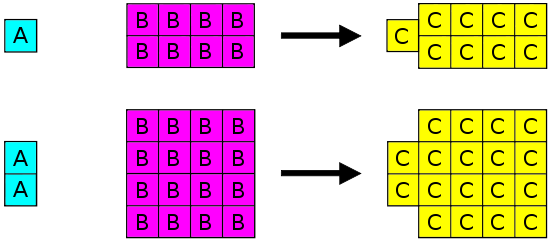
Law of Definite Proportions states that in a given blazon of chemic substance, the elements are always combined in the same proportions by mass.
The Law of Definite Proportions applies when elements are reacted together to class the same product. Therefore, while the Police of Definite Proportions can be used to compare two experiments in which hydrogen and oxygen react to form h2o, the Law of Definite Proportions tin can not be used to compare one experiment in which hydrogen and oxygen react to class water, and some other experiment in which hydrogen and oxygen react to form hydrogen peroxide (peroxide is another material that can be made from hydrogen and oxygen).
Oxygen makes up 88.8% of the mass of whatever sample of pure water, while hydrogen makes up the remaining xi.ii% of the mass. You can get water past melting ice or snow, by condensing steam, from river, sea, pond, etc. It tin can be from different places: U.s.a., Uk, Australia, or anywhere. Information technology can be made past chemical reactions like called-for hydrogen in oxygen.
Even so, if the water is pure, it will e'er consist of 88.viii % oxygen by mass and 11.2 % hydrogen by mass, irrespective of its source or method of preparation.
Law 3: Multiple Proportions
Many combinations of elements can react to course more than 1 compound. In such cases, this police force states that the weights of one chemical element that combine with a fixed weight of another of these elements are integer multiples of i another. It'southward easy to say this, but delight make sure that you empathize how information technology works. Nitrogen forms a very large number of oxides, five of which are shown here.
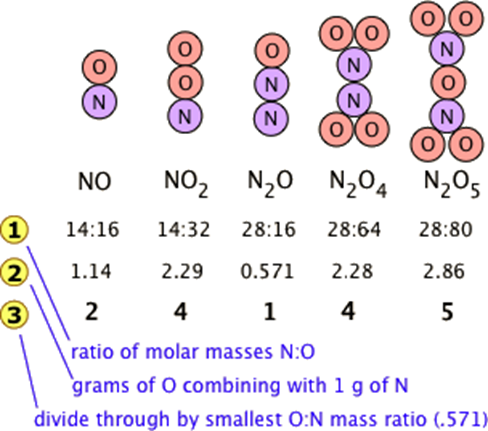
The law of multiple proportions states that if two elements form more than than one compound betwixt them, the masses of one element combined with a stock-still mass of the second element form in ratios of small integers.
Consider ii separate compounds are formed by only carbon and oxygen. The first compound contains 42.nine% carbon and 57.1% oxygen (by mass) and the 2d compound contains 27.iii% carbon and 72.vii% oxygen (once again past mass). Is this consistent with the police of multiple proportions?
Solution
The Law of Multiple Proportions states that the masses of one element which combine with a stock-still mass of the second element are in a ratio of whole numbers. Hence, the masses of oxygen in the two compounds that combine with a stock-still mass of carbon should be in a whole-number ratio.
Thus for every 1 1000 of the first chemical compound there are 0.57 m of oxygen and 0.429 one thousand of carbon. The mass of oxygen per gram carbon is:
\[ \dfrac{0.571\; \text{thousand oxygen}}{0.429 \;\text{g carbon}} = i.33\; \dfrac{\text{g oxygen}}{\text{g carbon}}\nonumber \]
Similarly, for 1 yard of the second compound, there are 0.727 g oxygen and 0.273 g of carbon. The ration of mass of oxygen per gram of carbon is
\[ \dfrac{0.727\; \text{one thousand oxygen}}{0.273 \;\text{g carbon}} = 2.66\; \dfrac{\text{g oxygen}}{\text{thousand carbon}}\nonumber \]
Dividing the mass of oxygen per g of carbon of the 2d compound:
\[\dfrac{ii.66}{i.33} = 2\nonumber \]
Hence the masses of oxygen combine with carbon in a ii:1 ratio which s consistent with the Constabulary of Multiple Proportions since they are whole numbers.
Dalton's Atomic Theory
The modernistic atomic theory, proposed nigh 1803 by the English chemist John Dalton (Figure \(\PageIndex{4}\)), is a fundamental concept that states that all elements are composed of atoms. Previously, an atom was defined as the smallest function of an element that maintains the identity of that element. Individual atoms are extremely small; even the largest atom has an approximate diameter of only 5.4 × x−10 m. With that size, it takes over 18 million of these atoms, lined up side past side, to equal the width of the human pinkie (well-nigh 1 cm).
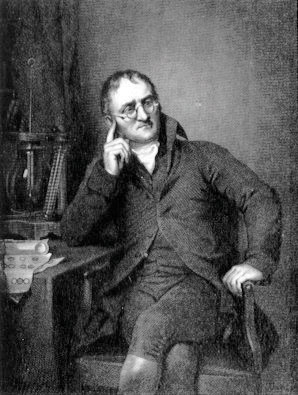
Dalton's ideas are chosen the modern atomic theory considering the concept of atoms is very old. The Greek philosophers Leucippus and Democritus originally introduced atomic concepts in the fifth century BC. (The give-and-take atom comes from the Greek word atomos, which ways "indivisible" or "uncuttable.") Dalton had something that the ancient Greek philosophers didn't take, however; he had experimental prove, such as the formulas of simple chemicals and the beliefs of gases. In the 150 years or so before Dalton, natural philosophy had been maturing into modern scientific discipline, and the scientific method was being used to study nature. When Dalton appear a modern atomic theory, he was proposing a fundamental theory to describe many previous observations of the natural world; he was not just participating in a philosophical give-and-take.
Dalton's Theory was a powerful development as information technology explained the three laws of chemical combination (above) and recognized a workable distinction between the fundamental particle of an chemical element (atom) and that of a compound (molecule). Half-dozen postulates are involved in Dalton's Atomic Theory:
- All matter consists of indivisible particles chosen atoms.
- Atoms of the same element are like in shape and mass, but differ from the atoms of other elements.
- Atoms cannot be created or destroyed.
- Atoms of different elements may combine with each other in a stock-still, elementary, whole number ratios to form compound atoms.
- Atoms of aforementioned element tin combine in more than than i ratio to grade ii or more compounds.
- The atom is the smallest unit of matter that can accept part in a chemical reaction.
In light of the current country of knowledge in the field of Chemistry, Dalton'south theory had a few drawbacks. According to Dalton's postulates,
- The indivisibility of an atom was proved wrong: an atom can be further subdivided into protons, neutrons and electrons. All the same an atom is the smallest particle that takes function in chemical reactions.
- According to Dalton, the atoms of same chemical element are similar in all respects. Still, atoms of some elements vary in their masses and densities. These atoms of different masses are called isotopes. For example, chlorine has ii isotopes with mass numbers 35 and 37.
- Dalton also claimed that atoms of different elements are unlike in all respects. This has been proven wrong in certain cases: argon and calcium atoms each have an same atomic mass (40 amu).
- According to Dalton, atoms of different elements combine in simple whole number ratios to form compounds. This is not observed in complex organic compounds like sugar (\(C_{12}H_{22}O_{eleven}\)).
- The theory fails to explicate the existence of allotropes (different forms of pure elements); it does not account for differences in properties of charcoal, graphite, diamond.
Despite these drawbacks, the importance of Dalton's theory should not be underestimated. He displayed exceptional insight into the nature of matter. and his ideas provided a framework that was afterwards modified and expanded past other. Consequentiually, John Dalton is frequently considered to be the father of modernistic atomic theory.
Fundamental Experiments in Chemistry: Primal Experiments in Chemistry, YouTube(opens in new window) [youtu.be]
References
- Petrucci, Ralph, William Harwood, Geoffrey Herring, and Jeffry Madura. Full general Chemistry. 9th ed. Upper Saddle River, New Jersey: Pearson Prentince Hall, 2007
- Moore, John. Chemistry for Dummies. John Wiley & Sons Inc, 2002.
- Asimov, Isaac. A Short History of Chemistry. , CT.: Greenwood Press, 1965.
- Patterson, Elizabeth C. John Dalton and the Atomic Theory. Garden City, NY: Doubleday, 1970
- Myers, Richard. The Basics of Chemistry. Greenwood, 2003
- Demtröder, Wolfgang. Atoms, Molecules and Photons: An Introduction to Diminutive- Molecular- and Breakthrough Physics. 1st ed. Springer. 2002
Summary
This article explains the theories that Dalton used equally a basis for his theory: (1) the Law of Conservation of Mass, (2) the Police force of Abiding Limerick, (3) the Law of Multiple Proportions.

Law Of Multiple Proportions Dalton,
Source: https://chem.libretexts.org/Courses/Ontario_Tech_University/OTU-_Chemistry_1010/02:_Atoms_Molecules_and_Ions/2.05:_The_Law_of_Multiple_Proportions_and_Daltons_Atomic_Theory
Posted by: jonessobjecold.blogspot.com
0 Response to "Law Of Multiple Proportions Dalton"
Post a Comment